Glass Fused Steel Tank Linings
26 Apr 2019
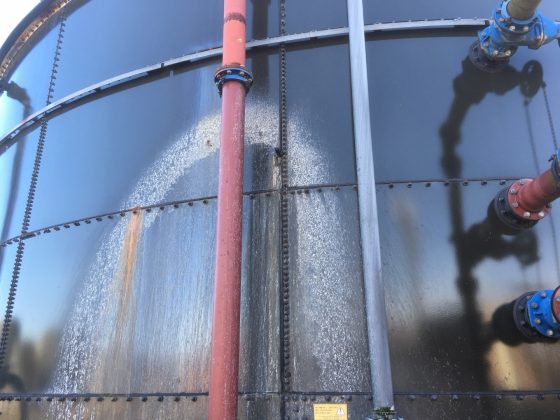
Sludge tanks are prone to leaking and this was evident in this particular application. The glass fused steel sludge tank was leaking effluent into the surrounding environment after only 8 years in operation. Suspected damage to the glass enamel had led to perforations once exposed to hydrogen sulphide, a biogenic sulphuric acid.
Industrial coatings and lining specialists, Corroless Eastern, selected LINE-X XS-350 pure polyurea as the most suited tank lining material.
Professional Preparation Equals a Robust, Long-Lasting Lining System
The tank had to be professionally cleaned before any works could commence. Once clean, all of the existing sealant was mechanically removed — essential in this type of tank, as the edges of the panels are not coated with the same glass enamel and this is where some of the worst corrosion can be found. Often other contractors simply over-coat this sealant, leaving a corrosion cell in place from which degradation of the tank structure will continue. The tank internals were then prepared by abrasive blasting, both to clean the glass enamel substrate and raise a mechanical profile for the new tank lining to adhere to. This blast profile was checked using a surface profile needle. To ensure optimum adhesion of the LINE-X XS-350 tank lining, all surfaces were washed using fresh water with the inclusion of an anti-corrosion inhibitor to prevent flash rusting of the steel. The tank internals were checked for soluble salts as part of Corroless Eastern's standard quality assurance — following the first wash, soluble salt levels were still found to be high, so a second wash was instigated. This was an excellent example of why a thorough testing and inspection regime is imperative when undertaking tank lining projects, since leftover soluble salts could lead to premature tank lining failure through osmotic blistering. The cleanliness of the tank internal was checked using a dust tape test.
Technical Knowledge and Experience Helps Develop the Right System for Different Applications
Glass fused steel is an extremely difficult surface to adhere to, even with abrasive blasting, because the surface profile created is not angular as per steel, meaning many epoxy, polyurethane and polyester materials struggle to gain sufficient adhesion. A specialist primer, developed by Corroless Eastern, was applied to ensure a strong adhesion to the glass fused steel. The primer was applied by airless spray to a thickness of 150 microns. To remove any risk of exceeding the re-coating window, a pigmented quartz aggregate was dressed into the wet resin to provide an excellent mechanical anchor for the polyurea tank lining to adhere to.
LINE-X as the Final Top Coat
LINE-X XS-350 was spray applied to a thickness of 2mm, with frequent dry film thickness readings taken during application. A DC holiday spark test was conducted to ensure a pin hole free finish — a single pin hole is a point of failure in a tank lining. Finally, termination points at the top and bottom of the polyurea lining were sealed using a polyurethane jointing compound to ensure a seamless finish. A high level of professionalism was carried out throughout the application process. Knowledge of the substrate, potential issues, primers and equipment is needed to provide a successful application, and numerous checks were made during the tank lining application to ensure the final tank liner would be fit for purpose for many years to come.
Both LINE-X UK (Head Office) and Corroless Eastern are extremely knowledgeable and have many years of experience with polyurea applications. If you would like to find out more, please contact LINE-X UK on 08000 198676, or use the contact form on this website.